
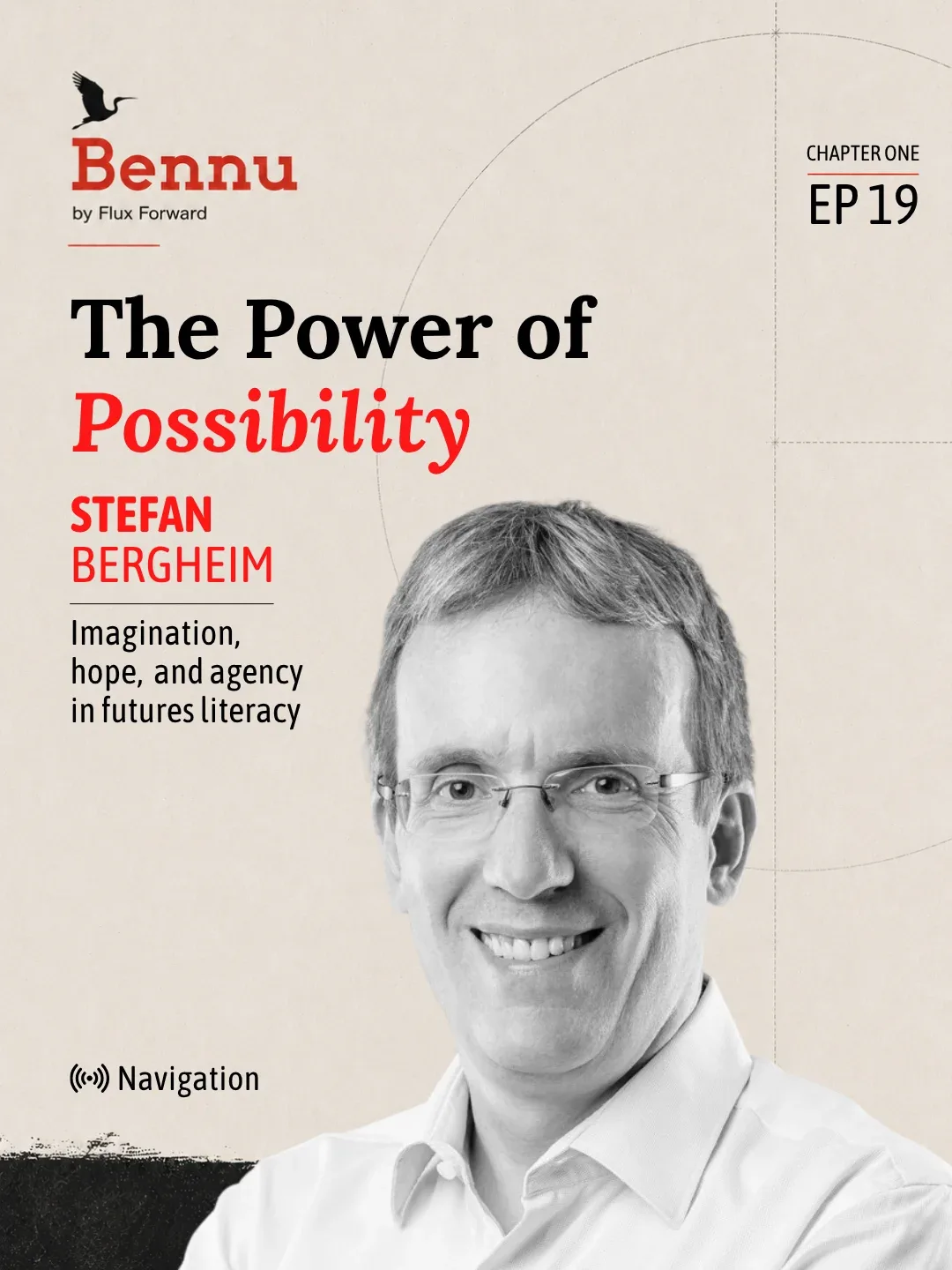
Bennu by Flux ForwardChapter One · Episode 19
The Power of Possibility
Stefan Bergheim on futures literacy, imagination, hope, and agency in uncertain times.
Where this connects
What this episode helps you notice.
Main thing to notice
Navigation
How you find your way through unfamiliar systems, choices, and routes.
Related skill
Visibility
How your value becomes easier for others to recognize.
What to do with this
Notice where this story points to a next step in your own context.
Browse related stories
Conversation frame
The Power of Possibility
Why this conversation still matters
Stefan Bergheim brings a rare path into futures literacy: from economic forecasting and GDP models to well-being, quality of life, participatory futures work, and Futures Literacy Labs.
This Bennu by Flux Forward conversation explores why the future is not one thing to predict, but a space for imagination, reflection, emergence, and action.
Many people and organizations still treat the future as something to forecast, control, or optimize. Stefan’s work offers a different posture: reveal the assumptions shaping your expectations, imagine alternative futures, listen to different perspectives, and use what emerges to act with more awareness in the present.
The main pattern in this episode is the shift beyond forecasting, toward possibility. Data and trends can be useful, but they are not the whole picture. Futures literacy creates room for imagination, emergence, seldom heard voices, and new ways of acting now.
Guest
Stefan Bergheim
A Bennu conversation about the human story behind a Flux Forward signal.
Open LinkedIn profileListen for
Notice where this story points to a next step in your own context.
- Navigation
- Visibility
Key signals
What the episode reveals.
Main pattern
Your experience becomes easier to use when you can name what it shows.
Bennu holds the story. Flux Forward helps turn it into a clearer next step.
Main thing to notice
Navigation
How you find your way through unfamiliar systems, choices, and routes.
Related skill or context
Visibility
How your value becomes easier for others to recognize.
Context
Context matters
Stefan Bergheim on futures literacy, imagination, hope, and agency in uncertain times.
What to try next
Start smaller
Look for one conversation, one clearer explanation, or one better example that would make the next step easier to act on.
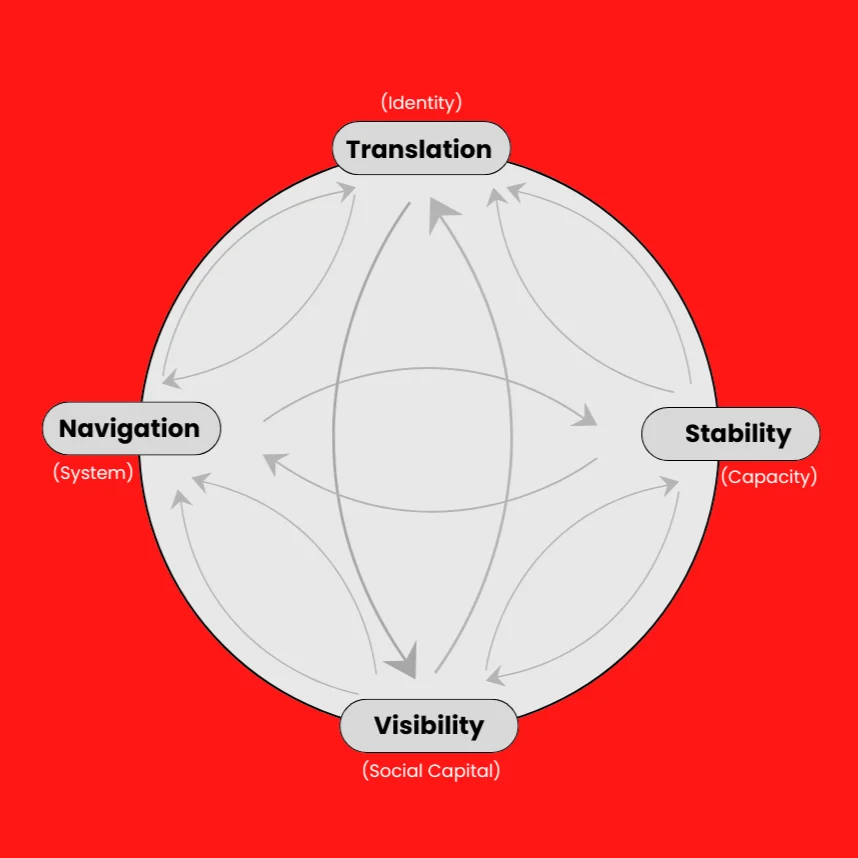
Activation mapping
How this story maps into activation.
Main signal
Navigation
- Primary
- Navigation
- Secondary
- Visibility
- Stability
- Supporting
- Translation
Everyday meaning
What this means in everyday life
This episode is about hope, imagination, and agency in uncertain times. Stefan shows that the future can be used as a space for reflection, not only prediction.
Imagine possibility
Hope becomes more practical when people can imagine alternatives and see where action might still be possible.
Question old measures
Well-being work asks whether the things we measure are the things that actually make life better.
Make room for emergence
Some insights appear when people stop forcing quick answers and allow new patterns to surface.
Practice agency
People regain movement when they see that uncertainty does not erase every choice.
Everyday question
Can possibility become a practical resource when the future feels closed?
Editorial Report
What this conversation reveals.
This conversation is about learning to use the future without trying to own it. Stefan Bergheim’s path begins in economic forecasting, where the future often appears as something to model, calculate, and control. Over time, his work moved toward well-being, quality of life, participation, and futures literacy: a practice that treats the future as a way to understand the present differently.
What stands out
The first thing that stands out is Stefan’s shift from prediction to possibility. He does not reject data or indicators. He still values measurement and stability where they are useful. But he also shows the limits of extrapolating from the past. Data can offer a baseline, not the whole horizon.
The second thing that stands out is the role of emergence. In Futures Literacy Labs, the facilitator can design the conditions, but cannot know in advance what new insight will appear. That is the point. Novelty is often confusing at first because it does not fit existing frames.
The third thing that stands out is the importance of revealing assumptions. Stefan reminds us that every image of the future comes from somewhere: family, culture, language, education, films, work, data, fear, or desire. When people notice those sources, they can begin to imagine differently.
The fourth thing that stands out is the relationship between hope, imagination, and agency. Stefan does not describe hope as naive optimism. Hope matters because it helps people stay in relationship with action. Without some image that contribution is possible, agency becomes harder to sustain.
Why it matters
Many international students, founders, educators, and professionals are trying to make decisions in conditions that cannot be fully predicted. This episode offers a practical shift: instead of asking only what will happen, ask what assumptions are shaping your expectations, what alternatives you can imagine, and what becomes possible in the present when you widen the frame.
Activation lens
This is a Navigation episode. It shows how futures literacy helps people move through uncertainty by using imagination, reflection, and participation. Visibility matters because assumptions need to be made visible. Stability matters because hope and some reliable baselines help people stay engaged. Translation matters because Stefan bridges economics, well-being, data, complexity, and collective imagination.
A question to carry
What future are you treating as obvious, and what becomes possible if you imagine that it is only one version among many?
Next steps
Where to go next
Start with one small step from here. Check your situation, clarify your profile, explore the wider context, or keep following the stories.